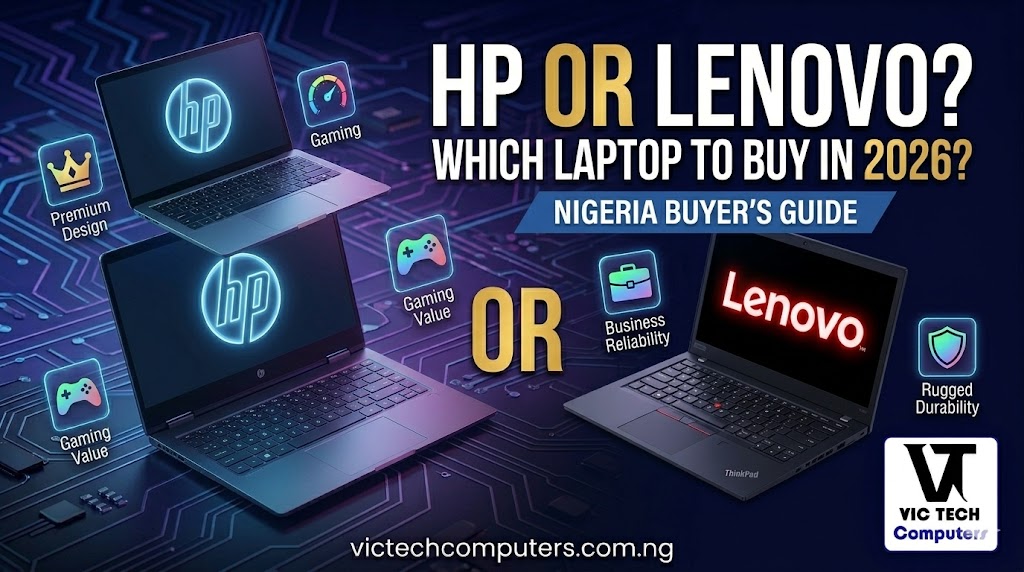
HP or Lenovo — Which Laptop Should You Actually Buy in Nigeria in 2026?
· June 5, 2026
Let me paint you a picture.
You walk into a computer store somewhere in Lagos or Abuja. You tell the seller your budget. He immediately puts two laptops in front of you — one HP, one Lenovo. Both look decent. Both are around your price range. He starts rattling off specs you barely understand. And now you’re standing there, confused, with real money in your pocket and absolutely no idea which one to pick.
This happens to thousands of Nigerians every single week.
The truth is, both HP and Lenovo are genuinely good laptop brands. Nobody is going to hand you a terrible laptop just because it has the wrong logo on the lid. But they are built differently, they feel different in daily use, and depending on what you actually do with a laptop — one of them will serve you significantly better than the other.
That’s exactly what this article is about. Let’s settle it properly.
First, a Little Background on Both Brands
HP has been around since 1939 — they’re an American company and one of the oldest names in personal computing. In Nigeria, you’ll mostly see their HP 250 series, HP Pavilion, HP Envy, and the gaming-focused HP Omen sitting on store shelves. People are drawn to HP because their laptops tend to look good — clean lines, nice finishes, and screens that genuinely pop.
Lenovo is a Chinese company and actually the biggest laptop manufacturer in the world right now by volume — they sell more laptops than anyone else on the planet. In Nigeria, the ones you’ll encounter most are the Lenovo IdeaPad (their budget range), Lenovo ThinkBook and ThinkPad (business-focused), the Lenovo Yoga (premium 2-in-1), and the Lenovo Legion for gaming. Lenovo’s reputation is built on one thing above everything else — reliability.
Both brands use the same Intel and AMD processors. Both offer options from budget to premium. So what’s actually different between them? Let’s go through it.
Build Quality — Which One Survives Real Life?
This matters a lot in Nigeria. Our laptops get carried in buses, stuffed into bags, used through long power cuts, and generally put through more daily stress than laptops in more comfortable environments. You need something that holds up.
Lenovo wins here, and it’s not particularly close. Lenovo’s ThinkPads use carbon fibre and recycled magnesium for strength without additional weight, and come with spill resistance and other durability features built in. Even their cheaper IdeaPad range tends to have solid hinges and chassis that don’t feel like they’ll crack if you look at them wrong.
HP’s mid-range and budget laptops — the ones most Nigerians are actually buying — use mostly plastic builds. They look nicer out of the box, but a year of daily use can start to show on them. The premium HP Spectre and Envy models use CNC-machined aluminium and feel fantastic, but those cost significantly more.
If you’re buying below ₦600,000, the Lenovo will generally outlast the HP in physical durability. That’s just the reality.
The Keyboard — Small Thing, Big Deal
Nobody talks about keyboards enough when buying laptops in Nigeria, and then people complain six months later that their fingers hurt after an hour of typing.
Lenovo’s keyboards — especially on their ThinkPad and ThinkBook lines — are genuinely some of the best in the laptop industry. The keys have good depth, satisfying feedback, and you can type on them for hours without fatigue. Their keyboards tend to have deeper key travel and better tactile feedback, which makes a real difference for people who type heavily every day.
HP keyboards are fine — they get the job done — but they feel shallower and a bit mushier compared to Lenovo’s. If you’re a student writing long essays, a journalist, a developer, or anyone who spends serious time typing, you will notice this difference.
The Screen — Where HP Genuinely Shines
Okay, so Lenovo has been winning the first few rounds. Here’s where HP fights back.
HP makes noticeably better screens — especially in their mid-to-premium range. Colours are brighter, more vibrant, and more accurate. HP Spectre laptops feature CNC-machined aluminium with Gorilla Glass displays, and their ENVY and Pavilion lines use designs that appeal strongly to mainstream users who care about the visual experience.
If you watch a lot of YouTube, Netflix, or you do any kind of design work — logos, social media graphics, video editing — an HP screen will make that work more enjoyable. Lenovo screens at the same price range tend to be more functional than impressive. They’re not bad, they just won’t make your jaw drop.
For most students and office workers, Lenovo’s screen is perfectly fine. But if your eyes are going to be on this screen for eight or more hours a day doing creative work, HP’s display quality is genuinely worth paying for.
Battery Life — Who Keeps the Lights On Longer?
Let’s be very real here. In Nigeria, your laptop battery isn’t just a convenience — it’s a survival tool. When NEPA takes light at 10am and your inverter dies at 2pm, your laptop battery is the only thing standing between you and a ruined work day.
Lenovo generally offers more consistent, reliable battery life across their product range. An IdeaPad or ThinkBook rated for 8 hours will typically get you somewhere close to that in real use. Lenovo’s X Power technology adapts to user-specific usage patterns, helping squeeze more life out of each charge over time.
HP has improved a lot in this area, and some of their newer premium models now offer exceptional battery life. But at the budget and mid-range levels where most Nigerian buyers shop, Lenovo is more consistent. You’re less likely to be unpleasantly surprised.
Performance — Does Brand Even Matter Here?
Honestly? At the same specs and price point, not much. A Lenovo with an Intel Core i5 and 8GB RAM will perform almost identically to an HP with the same processor and RAM. They’re running the same chips. The software and operating system are the same.
Where brand starts to matter for performance is cooling. The differences come from how laptops manage and control the heat generated by those chips — and some recent Lenovo ThinkPad models have faced criticism for loud fans and thermal struggles under heavy workloads. HP has had similar issues in certain models. This is why reading specific model reviews — not just brand comparisons — matters before you buy.
For gaming specifically, Lenovo Legion laptops offer better sustained performance and more competitive pricing than HP’s Omen equivalent at most price points.
Price and Value — Every Naira Counts
If budget is your primary concern — and for most Nigerian buyers it absolutely is — Lenovo offers slightly better value at the entry and mid-range levels. You tend to get more RAM, larger SSD storage, or a stronger build for the same naira compared to an equivalent HP.
HP commands a small premium, especially as you move up the range, partly because of their design reputation and display quality. Whether that premium is worth it depends entirely on what matters most to you.
So What’s the Final Answer?
Here it is, plain and simple:
Go with Lenovo if: Your priority is durability, you type a lot, battery life is critical for you, you’re on a tight budget, or you want a gaming laptop (Lenovo Legion is hard to beat at its price).
Go with HP if: You care about how your laptop looks and feels, you do creative work and need a better screen, or you’re buying in the premium range where HP’s design and display quality truly shine.
There’s no universally correct answer — there’s only the right answer for your situation. A university student in Abuja carrying a laptop to lectures daily will make a different choice from a Lagos-based graphic designer working from a fixed desk.
Figure out your priority first. Then make your choice.
Still not sure which specific model to buy? Browse the full comparison database at VicTechComputers.com.ng — we break down exact models, specs, and current prices in naira so you always know what you’re getting before you spend a single kobo.